IJ
Ivan Jovanovski
HomeProjectsLabResumeNowFuture Ideas
IJ
Ivan Jovanovski

Electrical Engineer building practical solutions in energy systems, automotive electronics, and embedded systems.

Navigation

  • Aerospace
  • Projects
  • Lab

Focus Areas

  • Energy Systems
  • Automotive Electronics

Connect

© 2026 Ivan Jovanovski. All rights reserved.

PET Bottle Recycler – Filament Extruder

recycling3D-printingRAMPSsustainabilityfilament
General
PET Bottle Recycler – Filament Extruder 1
🖼️1 / 2

Project Overview

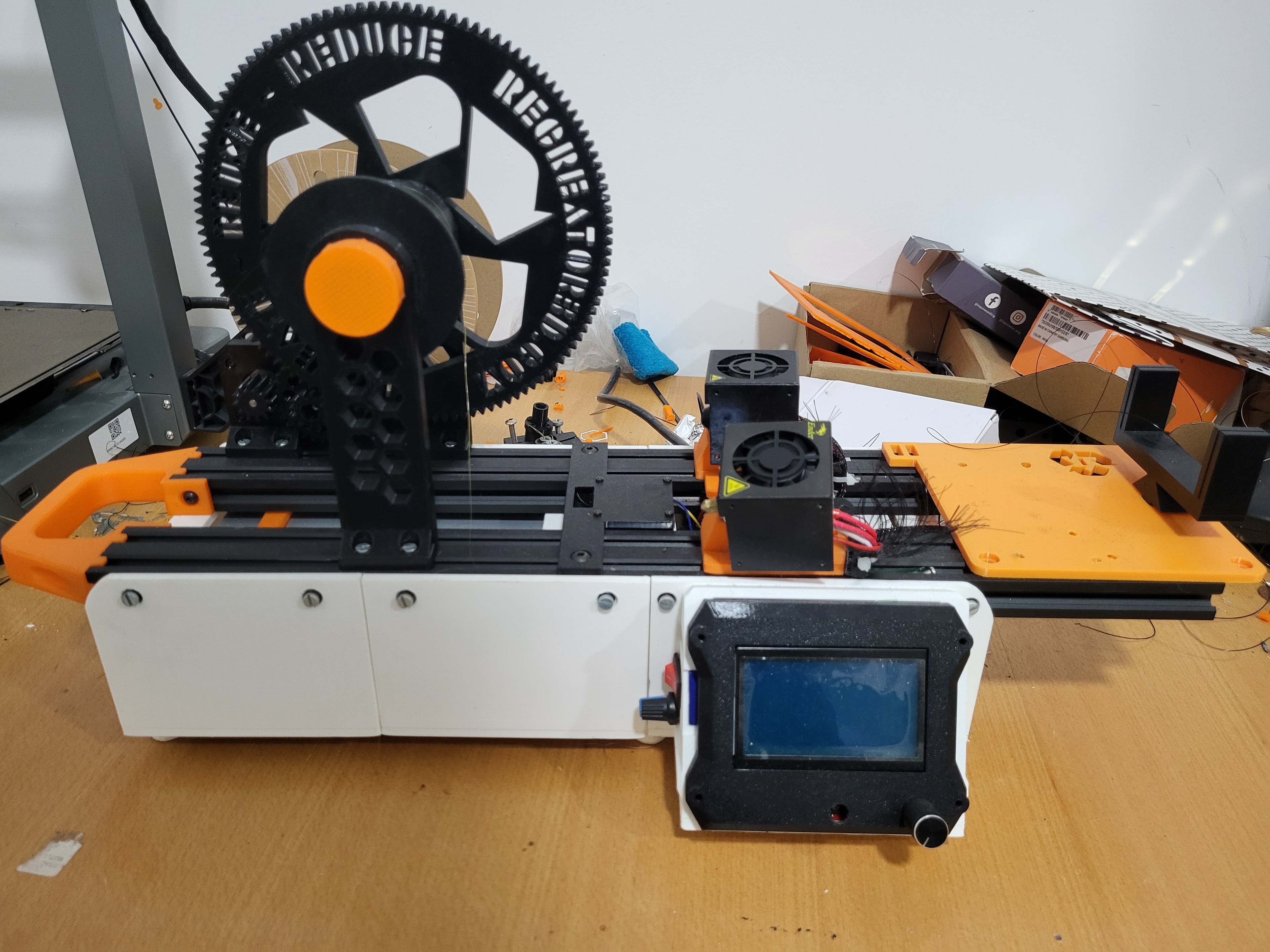
This project explores turning waste PET bottles into usable 3D printer filament and, at the same time, tests whether a RAMPS 1.4 board with a multi-hotend setup is a good base for a future, fully custom recycler. The idea is to build a small extruder that can melt PET strips cut from bottles and push them through a die to produce roughly 1.75 mm filament. The goal is not industrial throughput, but a working proof-of-concept that can recycle household plastic into something useful for prototyping and small prints while giving me a way to experiment with different hardware layouts, temperatures, and feed strategies before I commit to my own design. The mechanical layout and most of the 3D printed parts are based on existing open-source designs rather than original models. I am only adapting and wiring them for this setup; the 3D models themselves are not mine. All original creators are credited in the Parts, Sourcing & References section, and any files I share will clearly reference their work. This project is built upon the work of others, and I would like to acknowledge the contributions of the original creators of the open-source designs used in this project.

Version:v1.0
Time:~30.0 hours
Cost:~$150
Status:in-progress

Materials

  • RAMPS 1.4 control board with stock LCD × 1
  • NEMA 17 stepper motor (feed screw / extrusion drive) × 1
  • 3D printer hotend assemblies (used as dual heating zones) × 2
  • 40 W / 12 V heating cartridges × 2
  • 100K NTC thermistors × 2
  • 40 mm 12 V fans for hotend cooling × 2
  • 40–50 mm 12 V fan for filament cooling × 1
  • 2020/2040 aluminum extrusion for frame × 1
  • POM or TPU V-wheels for frame and guides × 5
  • Hilitchi-style M3/M4/M5 button-head screw assortment × 1
  • M4×8 mm hex socket head screws × 1
  • 2020-series M4 T-nuts × 1
  • 3D printed bottle-cutting jig and utility blade holder × 1
  • 3D printed mounts, guides, and spool parts × 1

Tools

  • 3D printer for brackets and jigs
  • Soldering station
  • Multimeter
  • Drill or drill press
  • Hex keys and screwdrivers
  • Calipers (for filament diameter checks)
  • Utility knife and deburring tools
  • Heat gun and compressed air (for bottle conditioning before cutting)

Contents

  1. 1.How It Works
  2. 2.Mechanical Build
    1. 2.1Bottle Cutting System
    2. 2.2Extrusion Section
    3. 2.3Puller & Spooler
  3. 3.Electronics & Control
    1. 3.1RAMPS 1.4 Setup
    2. 3.2Firmware & Control Modes
  4. 4.Future Hardware Upgrades
  5. 5.What I Learned
  6. 6.Parts & Sourcing
  7. 7.Resources & References

The aim is to build a PET filament extruder that can process plastic from discarded bottles and double as a test bench for a RAMPS 1.4–based, multi-hotend setup. Bottles are cut into a continuous strip, guided into a two-stage extrusion section built from off-the-shelf 3D printer hotends, and pushed through a 1.75 mm die. A passive spool on the output side handles filament storage, with tension set mechanically. Control is handled by a RAMPS 1.4 board and its stock LCD, running a stripped-down firmware configured for extrusion-only operation instead of full 3D printing.

The hardware layout follows an existing open-source design rather than being fully original, and this build is intentionally treated as an experiment: a way to see what works, what doesn’t, and what to change before designing my own recycler from scratch. All original model creators are credited in the project files and documentation.
Mechanically, the extruder is kept as simple as possible: a small aluminum frame holds the bottle cutter, feed screw, extrusion section, and spool in a straight line. The main challenge is keeping the feed path smooth so the PET strip doesn’t snag or twist before it reaches the hotends.

2.1

Bottle Cutting System

Bottles are converted into feedstock using a 3D printed cutting jig with a standard utility blade. The jig holds the bottle at a fixed offset so it can be rotated by hand and sliced into a continuous strip. The strip width is adjustable by changing the blade position and needs to be matched to the feed screw torque and overall throughput. The better and more consistent the cut, the easier it is to keep the extruder running without jams.

2.2

Extrusion Section

The hot part of the system is built from two complete 3D printer hotend assemblies mounted on a flat metal plate, which is then bolted to the frame rails. There is no custom machined barrel here—just a simple metal plate and standard hotends used in series. PET strip from the cutter is guided straight into the first hotend, where it is melted and pushed forward; the second hotend is mounted in line as an additional heating and pushing stage driven from the RAMPS heated-bed output. This two-stage setup is mainly experimental: it lets me see how a multi-hotend approach behaves with PET and what I would want to change in a future, fully custom design.

2.3

Puller & Spooler

Filament is driven by the NEMA 17 stepper in the hotend assembly and then guided onto a free-spinning spool. The spool has simple printed flanges and adjustable friction so it doesn’t back-drive the extruder or let the filament tangle. The goal is to keep the take-up system as mechanical and low-maintenance as possible while still keeping tension predictable.

Electronics & Control 1
Electronics & Control 2

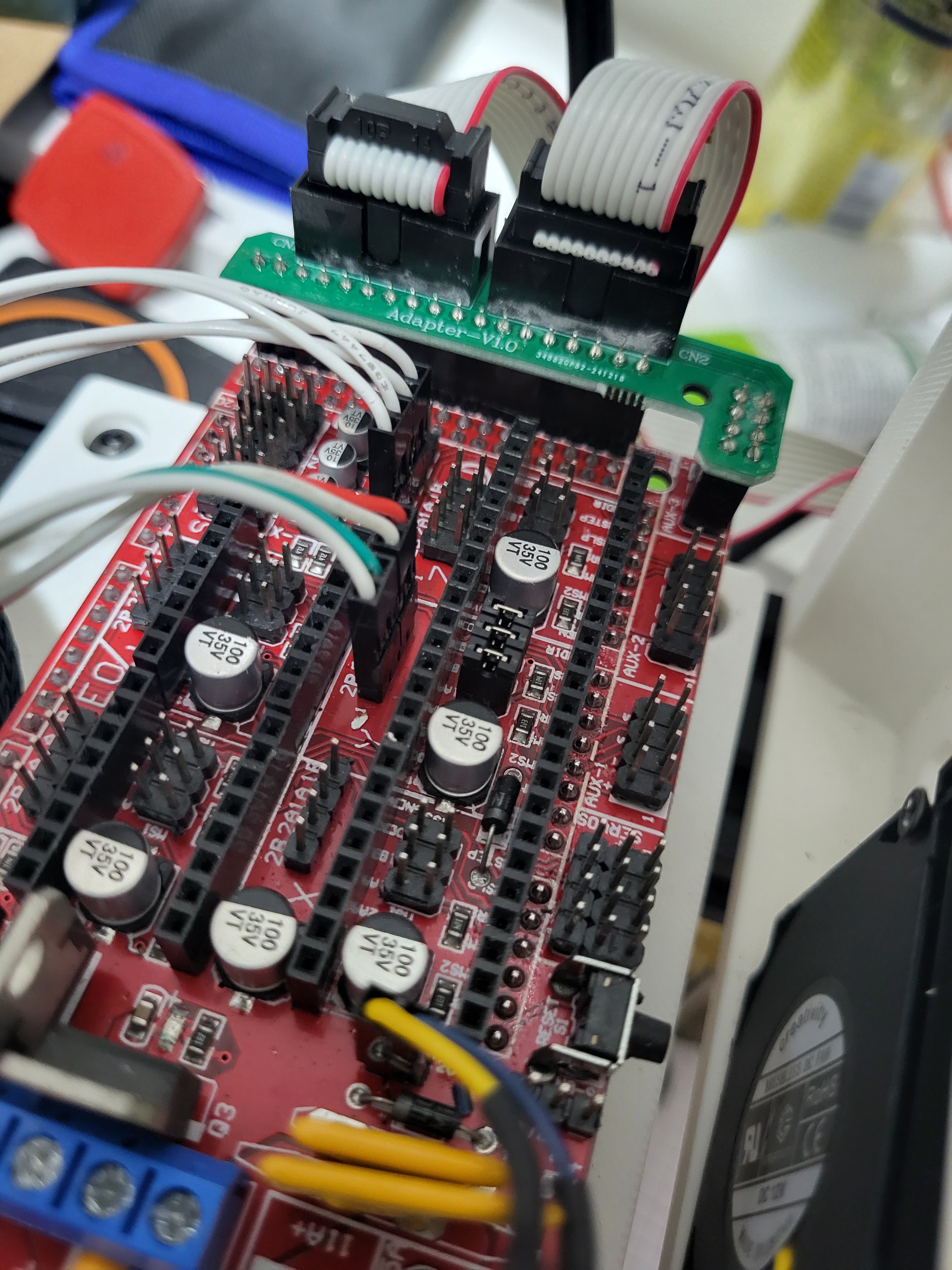
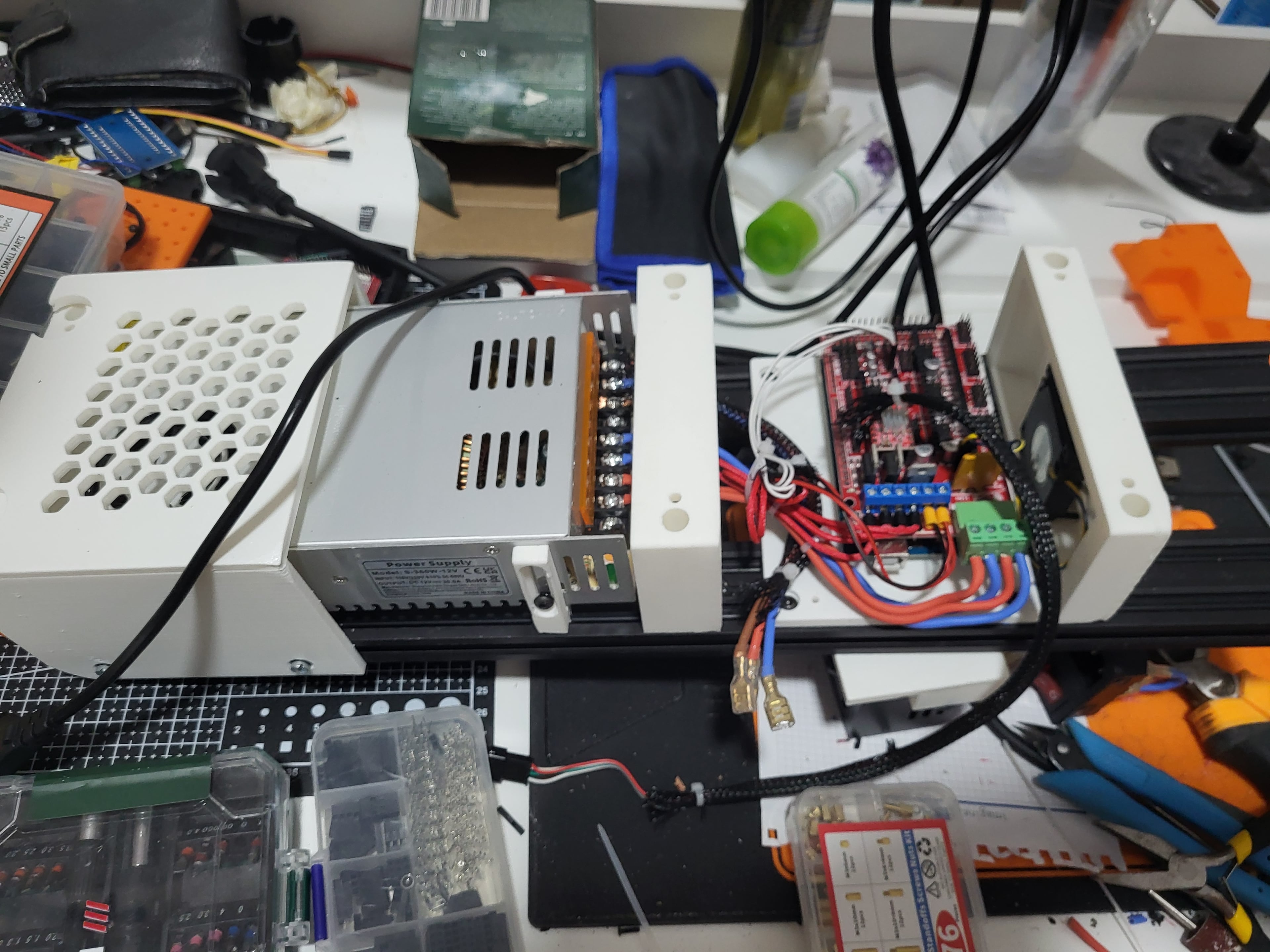
Electronics are based on a RAMPS 1.4 stack, which provides heater control, temperature sensing, and stepper driving. The role of a normal 3D printer is reduced to a single axis of motion: the feed screw, plus heater and fan control.

3.1

RAMPS 1.4 Setup

The RAMPS 1.4 board is used with its stock LCD as a basic control front-end. One stepper driver slot drives the NEMA 17 motor that turns the feed screw. The two hotends are wired to the hotend and heated-bed outputs, effectively giving two controllable temperature zones. Each hotend has its own 40 W cartridge heater and 100 K NTC thermistor wired back to the RAMPS for feedback. 12 V fans for the hotends and filament cooling are powered from the same supply, with at least one fan under firmware control for testing different cooling strategies.

3.2

Firmware & Control Modes

Firmware is based on a stripped-down Marlin configuration, with everything related to X/Y/Z motion and bed leveling disabled. Only heater control, a single extrusion axis, and a few fan outputs are left active. Temperature setpoints and feed rates are tuned manually from the LCD or over serial, with the intention of building up presets for different PET sources over time. Longer term, this setup is a stepping stone toward a simpler, extrusion-only control loop with a small status screen and basic safety checks.

Once this setup is properly understood, there are a few clear hardware upgrades worth trying. On the process side, the first step is to split cutting and extrusion into two separate stages: process full bottles into consistent PET strips first, store them, and only then feed those strips through the extruder. This should make the system more predictable than going directly from bottle to filament. On the hardware side, I want to experiment with different heater blocks and cartridges, better thermal isolation around the hotends, and a redesigned spooling system that keeps tension steady without too much tweaking.

PET is much fussier to work with than typical 3D printer filaments. It runs hotter, absorbs moisture easily, and reacts differently depending on the bottle it came from. Wall thickness turned out to be a real problem: some bottles are thin and soft, others are thick and stiff, and mixing them in one batch causes the required torque and flow rate to jump around. The closer you want to get to a clean 1.75 mm filament, the more important it is to stick to one or two bottle types with similar wall thickness.

One experiment that helped was heating the bottles with a heat gun before cutting and blowing compressed air inside them. That expands the bottle and thins the walls a bit, making the resulting strip more uniform and easier to feed. It also makes it possible to play with different wall thicknesses and see how each behaves through the same hotend setup without immediately choking the system.

Getting consistent filament diameter is still all about balancing temperature, feed rate, and spool tension. Too much heat or pull force and the filament necks down; too little and it comes out under-melted or lumpy. The second heating zone and a dedicated output cooling fan helped smooth out the melt, but only after a lot of small tweaks. I also started experimenting with insulating the heater blocks to see whether a more stable temperature profile along the hotend stack will improve melt behaviour and diameter stability.

Mechanically, even small misalignments in the bottle cutter or feed path showed up later as diameter ripple, so keeping the strip guide simple and straight mattered more than any fancy mechanics. One other lesson is that planning the wiring and control on something like RAMPS is worth the time, even for a small build. Having clear heater channels, thermistor mapping, and fan outputs documented made it easier to experiment without losing track of what was connected where.

The build reuses a lot of standard 3D printer hardware rather than starting from raw stock. The frame is based on 2020/2040 aluminum extrusions with V-wheels riding in the slots, held together with a mix of M3, M4, and M5 screws and 2020-series T-nuts. A generic screw kit (Hilitchi-style button-head assortment) covers most fasteners, with extra M4×8 mm screws and T-nuts for mounting brackets and guides.

The hot section uses two complete 3D printer hotend assemblies as separate heating zones. RAMPS 1.4 drives the first hotend on the main hotend output and the second on the heated-bed channel, each with its own 40 W cartridge heater and 100 K thermistor. Two 12 V fans cool the hotends, and a third fan is aimed at the filament right after it leaves the die.

A single NEMA 17 stepper motor drives the feed screw that pushes the PET strip through the extrusion section. The filament then winds onto a simple free-spinning spool with printed guides and adjustable friction. Most custom parts—the bottle-cutting jig, motor mounts, guides, and small brackets—are 3D printed. Off-the-shelf POM V-wheels can be used on the extrusion frame, but they can also be printed in TPU using the supplied files if needed.

This extruder started life as a remix of an existing PET pultrusion design for the Ender 3 platform and then turned into a dedicated test rig. The mechanical layout is heavily based on the Recreator 3D MK5Kit Ender3 Pultrusion Unit, with small changes to fit my parts, goals, and the RAMPS 1.4 electronics. All original model creators for the printed and metal parts are credited in the project documentation, and any downloadable files for this build clearly reference their work.

On the electronics and firmware side, RAMPS 1.4 documentation and the Marlin source code were the main references for reusing the hotend and heated-bed outputs as two independent heater channels. General community resources on PET filament recycling, drying, and extrusion helped with picking starting temperatures and feed rates.

Most of the custom parts were modeled in CAD and printed. Fusion 360 was used to edit metal parts, lay out brackets, and design the 3D printed components, while simple online STL box and panel generators helped with quick enclosures. For planning the wiring and connectors around the RAMPS board, a small schematic in an EDA tool like EasyEDA was enough to block out power rails, heater channels, thermistors, fans, and motor wiring.

Results

The current prototype produces usable PET filament from selected bottle types, with diameter close to 1.75 mm once temperatures, bottle choice, and spool tension are tuned. It is still an experimental setup, but already good enough for low-stress prints, test parts, and, most importantly, for learning what a future custom recycler should do differently.

  • Target filament diameter: 1.75 mm
  • Current tolerance (best runs): ±0.10 mm

Safety Notes

The system runs at high temperatures (250 °C and above) and uses mains-powered heaters and a DC power supply. Always keep hands and flammable materials away from the hot section, use proper ventilation when melting PET, and disconnect power before working on wiring. Heat-resistant gloves and eye protection are strongly recommended during testing.