The Macedonian Ecological Society organized a small competition at our faculty. The challenge was to improve the design of traps used for monitoring the Balkan lynx, one of the rarest cat species in Europe. The traps aren't meant to catch the animals permanently, just to hold them briefly while photos are captured for identification and research. The goal is to capture them, vaccinate them, take biological samples, and monitor the population health. The existing traps worked, but they had a problem.
Lynx Trap System
wildlifeconservationoutdoorscompetitionmechanical-design
Project Overview
This project was a bit different from my usual work. No microcontrollers, no code, no soldering. Just a mechanical problem, some springs, and a hike up a mountain.
Version:v1.0
Status:complete
The old design used a simple lever-based trigger mechanism. It was reliable, but not selective. The traps kept getting triggered by rabbits, martens, foxes, and other smaller animals passing through. Every false trigger meant wasted effort checking the trap and potentially scaring away the actual lynx from the area. The researchers needed something that would only trigger for an animal in the right weight range.
We did consider sensor-based solutions early on. Weight sensors, infrared triggers, even simple microcontroller setups that could distinguish animals by size or movement pattern. But the more we thought about the deployment conditions, the less practical any of that seemed. These traps go in very remote locations, hours from the nearest road. The environment is wet, cold in winter, and exposed year-round. Any electronic system would eventually need servicing, battery replacement, or repair, and that means someone hiking up a mountain every time something fails. A purely mechanical solution felt like the right call. No batteries, no circuit boards, nothing to corrode or malfunction. Just springs and metal.
Our team's idea was to replace the lever with a spring-loaded trigger calibrated to a specific force threshold. We worked with a local engineering firm to design springs with the right specifications, tuned to the weight range of an adult lynx. Too light, and the trigger wouldn't budge. Heavy enough, and it would release. It wasn't a complicated solution, but getting the tolerances right took some iteration. We built a few prototypes, tested them with weights, adjusted the spring constants, and eventually had something that worked consistently.
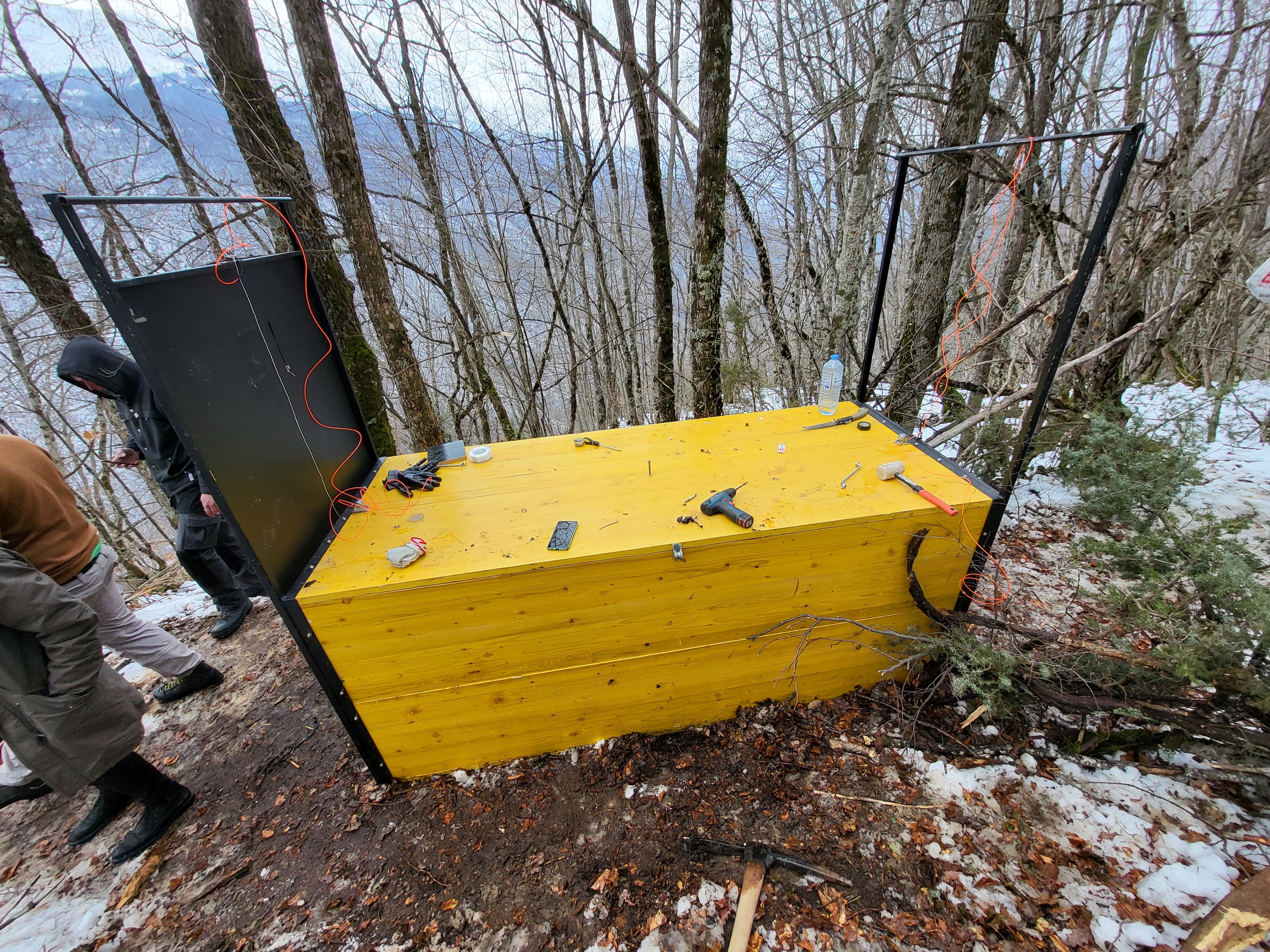
The real adventure was deployment. Lynx are elusive and avoid areas with human activity, which means the trap had to go somewhere remote. We hiked into Mavrovo National Park, carrying the cage disassembled in parts because there was no way to transport it whole. The trail wasn't really a trail after a while, just a general direction uphill through forest. After a few hours of hiking and some questionable navigation, we found a suitable spot, assembled the trap, set the trigger, and hoped for the best. Walking back down was easier, at least.
I don't know if our specific trap ever caught a lynx. The monitoring program is ongoing, and there are many traps across the region. But it was a nice change of pace from my usual projects. No screens, no debugging, just a mechanical puzzle and a day spent outdoors carrying heavy things up a mountain. Sometimes that's exactly what you need.
Thanks to the Macedonian Ecological Society for organizing the competition and for their ongoing work protecting the Balkan lynx. If you're interested in their conservation efforts, you can learn more at their website. Macedonian Ecological Society
Results
Successfully designed and deployed a spring-based trigger mechanism that discriminates by weight, reducing false triggers from smaller animals. The trap was installed in a remote location in Mavrovo National Park as part of the ongoing Balkan lynx monitoring program.